
September 7, 2026 · Updated: October 7, 2026 · Emre Kurt, Lawyer
Greece Golden Visa: €400,000 or €800,000 Region — Which to Choose?
€400,000 Zone B or €800,000 Zone A in the Golden Visa? A decision matrix by buyer profile, the 2026 market cooldown and concrete recommendations in this guide.
Deciding between the €400,000 and €800,000 thresholds in the Greece Golden Visa is a question with no single correct answer, depending entirely on the investor's profile. As of 2026 the market has gone through a two-year maturation process, and a clear picture has emerged of which profile really fits which region. In this article we examine the decision between the two thresholds through concrete buyer profiles, alongside current 2026 market data.
Who Is €800,000 Zone A Really Right For?
Market observers note that Zone A (€800,000) really addresses two fundamental buyer profiles:
Profile 1: The Genuine Athens/Island Lifestyle Buyer
This profile represents the investor who genuinely wants to live in Athens, Thessaloniki or a large island, has sufficient capital for it, and sees the Golden Visa as the regulatory facilitator of this lifestyle decision. For this person the 120 m² minimum-size requirement is not a restriction; they already want a serious, quality property, so Zone A's high pricing is justified by location.
Profile 2: The Article 5A Tax Planner
A high-net-worth investor with high foreign income considering the combination of an EU residence permit with the Non-Dom regime (€100,000 flat tax). For this profile the property is not a primary yield instrument; it plays a functional role as the "residence instrument" asset that combines residency and tax planning. The Golden Visa is a residence permit; it does not give a passport.
Who Is €800,000 Not Suitable For?
- Yield-focused investors: The short-term rental ban significantly weakens the income story.
- Investors seeking capital preservation in tourist areas: Exit liquidity can stay shallow in less busy Zone B markets.
- Investors targeting instant citizenship: The Golden Visa is a residence permit, not citizenship. Whichever threshold is chosen, citizenship requires 7 years of actual residence plus an exam; Golden Visa years alone do not give a passport, and a higher investment does not shorten this period.
€400,000 Zone B: Ideal for Whom, Risky for Whom?
Zone B's most active and notable opportunity is in the areas outside Attica within 1-2 hours of Athens (e.g. Corinthia, Viotia); this area is described as 2026's most active investment corridor. At €400,000 instead of €800,000 it gives the same residence permit and Schengen travel rights and offers a much wider range of options.
But the risk should not be ignored either: on small islands with a population under 1,000, the sale period can extend to between 2 and 5 years; the buyer pool on these islands consists mostly of lifestyle-focused foreign buyers, with no local market mechanism. So within Zone B too, the question of "which Zone B" carries great importance.
Comparison of the Two Profiles
| Profile | Suitable for €800K Zone A | Suitable for €400K Zone B |
|---|---|---|
| Genuine lifestyle buyer | Yes — a person who genuinely wants to live in Athens/an island, with capital | No — Zone A makes sense for this profile |
| Article 5A tax planner | Yes — the property is the "residence instrument" of the Non-Dom + residency combination | Partly — a lower entry cost may be preferable |
| Yield-focused investor | No — the STR ban weakens the income story | Yes — especially in inland cities (Larissa, Ioannina) |
| Capital preservation priority | Yes — in liquid centres like Athens/Thessaloniki | Be careful — exit liquidity can be shallow in tourist Zone B markets |
| Cost minimisation | No — Zone A is illogical with this goal | Yes — especially areas outside Attica within 1-2 hours of Athens |
⚠️ 2026 Market Cooldown Signal
According to Bank of Greece data, foreign capital inflow fell about 24% in the January-September 2025 period compared with the same period the previous year; this means a decline from about €1.925 billion to €1.46 billion. This data is concrete evidence that the 2024 threshold increases really cooled the market. The assumption that "the Greece Golden Visa market keeps growing under all conditions" is no longer valid as of 2026; it is therefore important to consider current market dynamics when making an investment decision.
An Interesting Detail: On Some €800,000 Islands the Threshold Is Already "Not Binding"
In the main settlements of islands like Paros, Naxos, Tinos, Rhodes, Corfu and Zakynthos, property prices already run above €800,000; this means the threshold is a theoretical limit in these areas and the real investment decision should be made through the rental/use model rather than the threshold. When searching for property on these islands, the question becomes not "don't exceed €800,000" but "where do I find the best value at this price level".
Final Decision Matrix
| Priority | Choice |
|---|---|
| Genuine Athens/island living + prestige | €800K Zone A |
| Non-Dom/tax planning | €800K Zone A (property as a residence instrument) |
| Maximum yield | €400K Zone B (especially inland cities) |
| Liquidity + Schengen access, low cost | €400K areas outside Attica, 1-2 hours from Athens |
| Small-island lifestyle (liquidity risk acceptable) | €400K small islands |
Conclusion: The Right Question Is Not "Which Is Better"
As of 2026 the Greece Golden Visa market has a far more mature and segmented structure than five years ago. There is no universal answer to "is €400,000 or €800,000 better"; the right question should be "which threshold suits my profile and goals". For those acting on a genuine lifestyle decision or a tax-planning strategy, €800,000 is self-consistent; for those prioritising yield, liquidity or cost minimisation, €400,000 generally offers a more rational choice.
Let's take the right step toward your Greece Golden Visa together.
From choosing the right project to the application and residency, we are with you end to end.
Get a Free ConsultationFrequently Asked Questions
1. Is €400,000 or €800,000 generally a better investment?
There is no universally "better" option; the decision depends entirely on the investor's profile and goal. €800,000 has a self-consistent logic for investors who genuinely want to live in Athens or a large island, or who are doing Non-Dom tax planning. €400,000 is generally a more rational choice for yield-focused investors, those prioritising liquidity, or those targeting cost minimisation. When deciding, asking "which threshold suits my goal" rather than "which is better" is a more correct approach.
2. For which two profiles does the €800,000 investment really make sense?
The first profile is the investor who genuinely wants to live in Athens, Thessaloniki or a large island and has the capital for it; for this person the Golden Visa serves as the regulatory facilitator of a lifestyle decision they already planned. The second profile is the investor with high foreign income considering the combination of an EU residence permit with the Non-Dom regime (€100,000 flat tax); for this profile the property is not a primary yield instrument but functions as the "residence instrument" asset that combines residency and tax planning (the Golden Visa is a residence permit, not a passport).
3. Where is the most active opportunity in €400,000 Zone B?
As of 2026, the most active and notable opportunity in Zone B is in the areas outside Attica within 1-2 hours of Athens (e.g. Corinthia, Viotia); this area is described as the year's most active investment corridor. At €400,000 instead of €800,000 it gives the same residence permit and Schengen travel rights and keeps relative proximity to the centre. But there are also risks to watch for within Zone B; especially on small islands with a population under 1,000, the sale period can extend to 2-5 years, so when choosing Zone B, the liquidity profile of the specific location must be carefully assessed.
4. Is there a cooldown in the Golden Visa market in 2026?
Yes, concrete data shows it. According to Bank of Greece data, foreign capital inflow fell about 24% in the January-September 2025 period compared with the same period the previous year (from about €1.925 billion to €1.46 billion). This is seen as concrete evidence that the 2024 threshold increases really cooled the market. So when making an investment decision, it is important to act on current and realistic market dynamics rather than the assumption that the market grows uninterrupted.
5. On islands like Mykonos or Rhodes, is the €800,000 threshold really decisive?
Actually no, in most cases it is not. In the main settlements of islands like Paros, Naxos, Tinos, Rhodes, Corfu and Zakynthos, property prices already run above €800,000; this means the threshold is a theoretical limit in these areas and not binding in practice. When deciding on these islands, what really matters is not the threshold itself but the rental/use model and which property offers the best value at this price level. Investors considering investing on these islands are therefore advised to search for property with a value-focused rather than threshold-focused approach.
Note: The market data and assessments in this article are based on general observations and do not constitute investment advice. Contact us to determine together the threshold and region most suitable for your profile and goals.

Thessaloniki Centre · ThessalonikiGA-51
Thessaloniki City Centre Twin Lofts
Two lofts in central Thessaloniki being converted from commercial to residential use: about 70 m² each, with a double-height living space and a mezzanine bedroom. Each is Golden Visa eligible at €250,000.
- Beds
- 1 bed
- Energy Class
- A
- Delivery
- Under renovation · date on request

Peristeri · AthensGA-41
Peristeri Residences
A boutique project in Peristeri, a lively district of west Athens, where an older building is being converted into 14 apartments: 32–65 m², mostly two-bedroom, delivered furnished, with a top-floor apartment featuring a private roof terrace. Eligible for the €250,000 Golden Visa, €250,000–292,500.
- Beds
- 1–2 bed
- Energy Class
- —
- Delivery
- 2027
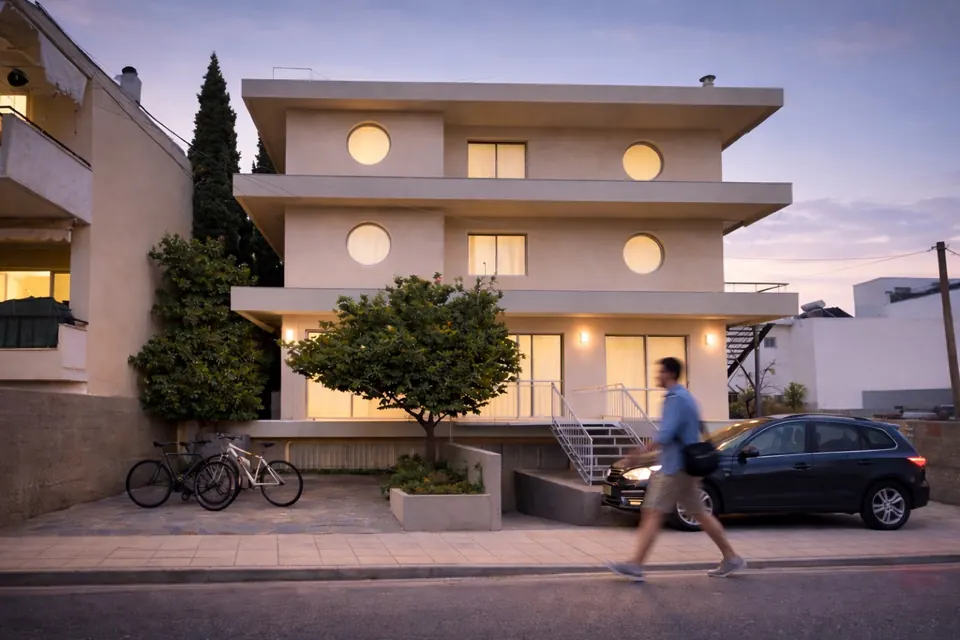
Gerakas · AthensGA-19
Gerakas Residences
A €250,000 Golden Visa conversion in Gerakas — an office turned into homes: compact one-bedrooms from €250,000.
- Beds
- 1 bed
- Energy Class
- —
- Delivery
- 2027